

SIRI Law LLP - Network Penetration Testing
Network Penetration Testing
Strengthen Your Infrastructure — Identify Network Weaknesses, Eliminate Attack Paths & Protect Critical Business Operations.
Network Security Testing at SIRI Law LLP – Cybersecurity & Compliance Division

Your network is the backbone of your digital environment — and one of the most targeted components by cybercriminals.
Misconfigurations, open ports, weak segmentation, exposed services, outdated protocols, and poorly managed credentials can create entry points for ransomware, data breaches, and lateral movement attacks.
At SIRI Law LLP (Cybersecurity & Compliance Division), our Network Security Testing service delivers a complete examination of both external-facing and internal enterprise networks, uncovering vulnerabilities before attackers can exploit them.
We combine industry-leading offensive security techniques, zero-trust analysis, and legal-compliance oversight to ensure your network is:
Secure
Compliant
Resilient
Audit-ready
Legally defensible
Whether you manage on-premise infrastructure, hybrid networks, or cloud-connected environments, SIRI provides a comprehensive, regulator-aligned network security assessment.
Our Network Security Testing Methodology
- Define scope and objectives: Outline network components, devices, and environments to be tested, including internal, external, and cloud-based elements.
Reconnaissance: Collect information on network architecture, services, and open ports using active and passive methods (e.g., WHOIS, Nmap scans).
Vulnerability scanning: Run automated tools like Nessus or OpenVAS to identify known vulnerabilities in network systems and services.
Manual validation: Validate and exploit discovered vulnerabilities to assess their severity and potential impact on the network.
Network device review: Analyze configurations of firewalls, routers, and switches for misconfigurations, outdated firmware, and weak access controls.
Authentication testing: Evaluate network authentication methods for weaknesses, testing for brute force or credential-based attacks on services like SSH, VPNs, or RDP.
Encryption testing: Test the strength of encryption protocols in use, including VPNs, Wi-Fi networks, and communication channels.
Lateral movement testing: Once initial access is gained, attempt to move laterally through the network to uncover additional vulnerabilities or escalations.
Remote access and endpoint review: Test remote access solutions (e.g., VPN, RDP) and ensure endpoints are adequately secured with antivirus or EDR tools.
Document findings and remediation: Provide a detailed report with actionable remediation steps, and validate fixes by retesting post-patching.
Patch Assisted
Architecture Flaws
In-depth Validation
Firewall Analysis
Network Penetration Testing Process
Our established network penetration testing methodology delivers comprehensive testing and actionable recommendations.
Analyze
the network architecture
Threat Model
real attacker behavior
Passive/Active Testing
with expert manual exploitation
Firewall Analysis
Reporting
with risks, PoCs & remediation
Why Choose SIRI Law LLP for Network Security Testing?
Comprehensive coverage: We test all network layers, internal and external, to uncover vulnerabilities at every touchpoint.
Advanced attack simulations: Real-world attack scenarios identify hidden security weaknesses.
Tailored approach: Our testing adapts to your network’s unique environment for precise results.
Industry standard alignment: We follow frameworks like NIST, OWASP, and PCI DSS for compliance and reliability.
Thorough vulnerability exploitation: We assess not just vulnerabilities but their exploitability and potential impact.
Zero false positives: We ensure only real vulnerabilities are reported, saving time and resources.
Actionable reporting: Clear reports with specific remediation steps for faster resolution.
Continuous testing: Post-remediation testing ensures vulnerabilities are fixed and network security is maintained.
Proven track record: Experience in regulated industries like healthcare, finance, and government.
Ongoing support: We provide real-time updates and guidance throughout the engagement.
Five areas of Network and Infrastructure Security
Hardware Pentest
Hardware penetration testing is a critical assessment process aimed at identifying vulnerabilities in physical devices and their associated systems. This testing involves a comprehensive evaluation of hardware components, firmware, and communication interfaces to uncover potential security weaknesses that could be exploited by malicious actors. By simulating real-world attack scenarios, security professionals assess the effectiveness of physical security measures, analyze firmware for flaws, and evaluate the robustness of communication protocols. The ultimate goal is to provide organizations with actionable insights and recommendations to strengthen their hardware security posture, ensuring that devices are resilient against emerging threats and safeguarding sensitive data from unauthorized access.
Cloud Security / Penetration Testing
Cloud security is a vital discipline focused on safeguarding data, applications, and infrastructure within cloud environments. It encompasses a broad range of practices and technologies designed to protect cloud-based systems from internal and external threats. This includes securing data storage, managing access controls, monitoring for unauthorized activities, and ensuring compliance with industry standards. Cloud security assessments involve evaluating the configuration of cloud services, identifying misconfigurations, and testing identity and access management (IAM) policies to detect potential weaknesses. By implementing robust cloud security measures, organizations can maintain the confidentiality, integrity, and availability of their cloud assets, ensuring secure and resilient operations across public, private, and hybrid cloud infrastructures.
AI/LLM PenTest
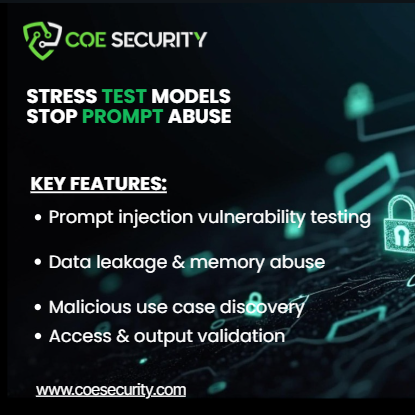
At COE Security, our AI and Large Language Model (LLM) Penetration Testing service is tailored to evaluate the security of AI-driven applications and systems. As organizations increasingly leverage AI and LLMs for various functions, understanding their vulnerabilities is crucial. Our team conducts comprehensive assessments that focus on potential risks associated with model training data, API endpoints, and user interactions. By simulating real-world attack scenarios, we identify weaknesses such as data poisoning, model inversion, and adversarial attacks. The insights gained from our testing help organizations enhance their AI security measures, ensuring robust protection against emerging threats while maintaining compliance with relevant standards. Our goal is to empower you to harness the full potential of AI technologies while safeguarding your systems and data.
DevOps Security Testing
At COE Security, our DevOps Security Testing service integrates security practices into the DevOps pipeline, ensuring that security is a fundamental component throughout the software development lifecycle. We emphasize the importance of proactive security measures, conducting assessments at various stages, from code development to deployment. Our approach includes automated scanning for vulnerabilities, manual code reviews, and configuration assessments to identify potential security risks early in the process. By collaborating closely with development and operations teams, we help foster a culture of security awareness and compliance. The insights gained from our testing enable organizations to address vulnerabilities swiftly and effectively, ultimately enhancing the security of applications and infrastructure while maintaining the agility and efficiency that DevOps offers.
Firmware Security
Firmware forms the foundation of hardware functionality and is increasingly targeted by attackers. Our Firmware Security Testing service focuses on identifying vulnerabilities such as insecure boot processes, hardcoded credentials, and unprotected firmware updates. We analyze firmware binaries, configuration files, and underlying code to detect and address risks. To support your engineering team, we provide actionable remediation insights and secure coding recommendations, ensuring your firmware is resilient against both known and emerging threats. With our assistance, you can safeguard your devices and maintain trust in your hardware solutions.
Why Partner with SIRI for Network Security?
“Your trusted ally in uncovering risks, strengthening defenses, and enabling secure innovation.”
Expert Team
Certified security engineers + legal & compliance specialists.
Standards-Based Approach
Aligned with OWASP, NIST, SANS, ISO, and global cybersecurity frameworks.